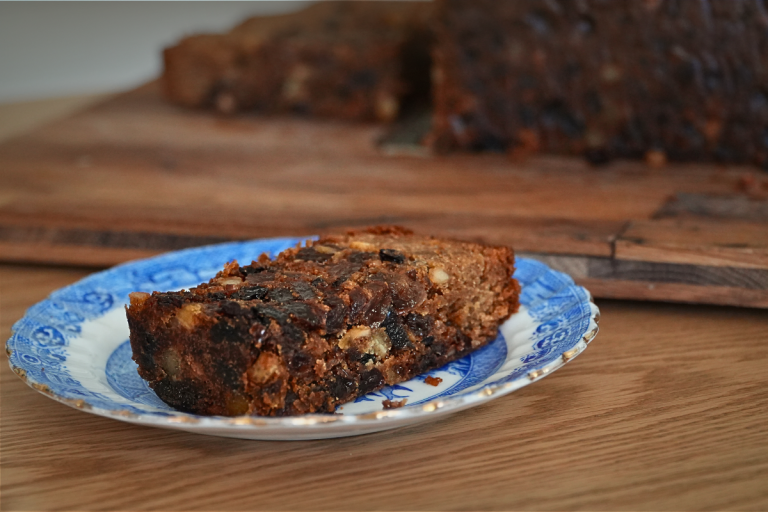
100-Year-Old Fruit Cake Recipe (A Beautiful 1928 Christmas Cake)
Prep Time: 45 minutes
Cook Time: 4 hours
Servings: 24 slices
A rich, moist, deeply flavoured fruit cake based on a recipe first published in The Schauer Cookery Book (1928). Packed with dried fruit, lightly spiced, slow-baked, and beautifully old-fashioned — this heritage cake tastes even better with age. Works perfectly with gluten-free flour.
Ingredients
Dry Ingredients
- 570 g plain flour (1¼ lb) or gluten-free plain flour; no binders needed
- 1 tsp bi-carb soda (baking soda)
- ½ tsp salt
- 1 tbsp mixed spice
- 1 whole nutmeg finely grated
Fruit & Nuts - Lee’s Version
- My fruit packets weren’t full pounds, so I adjusted the mix slightly (mostly by adding extra sultanas). If you’d like the pound equivalents and the original 1928 fruit list, please see the Notes section below.
- 375 g raisins chopped (each raisin cut in half or finely chopped)
- 625 g sultanas
- 300 g currants
- 150 g glacé cherries washed, dried and quartered (larger ones cut smaller)
- 200 g mixed peel
- 150 g blanched almonds chopped small
Wet Ingredients
- 450 g very soft unsalted butter (1 lb)
- 450 g light brown sugar (1 lb) or caster sugar
- 2 tbsp treacle
- 10 large eggs room temperature (about 60 g each)
- 180 ml brandy or rum 1 small teacup; optional – the cake also works without spirits
- Finely grated zest of 1 orange
- Finely grated zest of 1 lemon
- Juice of 1 orange
Instructions
Prepare the Tin
- Use a 23 cm square or round, deep cake tin (the deeper the better). A removable base makes it easier to unmould.
- Line the base and sides with:
- 2 layers of brown paper (e.g. brown paper bags), and
- 1 layer of baking paper on top of the brown paper.
- Let the paper extend about 3–4 cm (1–1½ inches) above the rim of the tin.
- You can use a tiny smear of butter between the paper layers just to help them stick together and stay in place.
Prepare the Dry Ingredients & Fruit
- Sift the flour and bi-carb soda twice into a very large bowl.
- Whisk in the salt, mixed spice and grated nutmeg so they’re evenly distributed.
- Add all the prepared fruit and nuts: chopped raisins, sultanas, currants, chopped glacé cherries, mixed peel, chopped blanched almonds.
- Using your hands is easiest: toss the fruit and nuts through the flour until everything is well coated. This helps with even distribution later.
Cream the Butter, Sugar & Treacle
- In your largest mixing bowl, add the soft unsalted butter, light brown sugar, and treacle.
- Beat with a mixer until the mixture is light and creamy. This will take a few minutes.
Add the Eggs, Brandy and Citrus
- Lightly beat the 10 eggs together in a jug if using a hand mixer, or keep them whole if using a stand mixer.
- Add the eggs a little at a time, beating well between each addition so the mixture stays as smooth as possible.
- Slowly pour in the brandy or rum (if using) while mixing on low speed.
- Add the orange zest, lemon zest, and the juice of the orange.
- The mixture may look slightly curdled at this point – that’s normal and will be corrected once the flour and fruit go in.
Combine Wet & Dry
- Add half of the flour-and-fruit mixture into the wet mixture. Stir with a sturdy wooden spoon until combined.
- Add the remaining flour and mix again.
- The batter will be very heavy and fruit-packed – this is exactly how it should be.
Fill the Tin
- Spoon the mixture into the prepared tin, trying not to smear it too far up the sides.
- Use a knife or skewer to stab through the mixture several times to remove any large air pockets.
- Dip your hand in cold water and gently pat the top flat. This helps it bake evenly and gives a nice finish.
Prepare for Baking
- Place a few folded sheets of brown paper in the base of a large roasting pan.
- Set the filled cake tin on top of the paper in the roasting pan – this extra cushioning protects the base from too much direct heat.
- Preheat your oven to:
- 130°C (265°F) conventional, or
- 110°C (230°F) fan-forced.
- This is a very slow oven – exactly what this cake needs.
Bake the Cake
- Gently place the cake into the lower third of your preheated oven.
- After about 2 hours, check the top. If it’s already a good colour, lay a loose sheet of baking paper over the top (don’t seal it tightly) to prevent over-browning.
- Continue baking until a skewer inserted into the centre comes out clean.
- Depending on your oven, it may take up to 4–5 hours. In my oven it took 4 hours.
- When done, the cake will be:
- beautifully flat on top
- golden-brown
- and a skewer will come out clean.
Brush with Brandy or Rum & Cool Overnight
- As soon as the cake comes out of the oven, brush the top with 1–2 tablespoons of brandy or rum while it’s still very warm. This helps preserve and flavour the cake.
- Drape clean tea towels loosely over and around the tin – you want it covered, but still able to breathe.
- Leave the cake to cool in the tin overnight.
Unmould and Slice
- The next day, lift the cake from the tin. If your tin doesn’t have a removable base, place a board on top, invert the cake out, then invert again so it’s sitting upright.
- Carefully peel away all the brown paper and baking paper.
- Place the cake on a wire rack and let it breathe for about 1 hour before slicing.
- To slice:
- Run a knife under hot water, dry it and cut thick slices.
- Wipe the knife between cuts for neat slices.
Video
Notes
About the Recipe & Fruit Settling
This recipe comes from the Schauer Cookery Book, first published in 1928, and the method has stayed the same ever since. It has an extremely high ratio of fruit to flour (around 3:1), a very soft batter, and a long, slow bake. It’s completely normal for older-style fruit cakes like this to have a denser fruit layer toward the lower half of the cake – this is part of the traditional texture and not a fault.Gluten-Free Version
This recipe works beautifully with a 1:1 swap for gluten-free plain flour. You don’t need to add xanthan gum or other binders. The long, gentle bake and high fruit content help the cake hold together well.Fruit Preparation
Chop raisins, cherries and almonds so they’re roughly sultana-sized. Smaller pieces help the cake slice neatly. Wash and dry glacé cherries well before chopping to remove excess syrup.Mixed Spice Alternatives
Mixed spice is common in Australia, the UK, New Zealand and South Africa, but it can be harder to find in the United States, Canada and many parts of Europe. If you can’t get it, use one of these easy substitutes:- Pumpkin pie spice – closest flavour match and widely available in the US (use the same amount).
- Apple pie spice – also works well; add a pinch of nutmeg for a more traditional flavour.
- DIY blend: 1 teaspoon cinnamon, ¼ teaspoon nutmeg and ¼ teaspoon allspice (or a tiny pinch of ginger or cloves).
- Allspice only: use half the amount, as it has a stronger, more concentrated flavour.
Storage
Once the cake is completely cool, wrap it in baking paper, then foil. Store in:- a tin in a cool, dark cupboard (if cool/dry), or
- the fridge (if warm/humid)
Feeding the Cake
Because this cake already contains brandy (if used) and is brushed with extra on top, there’s no need to feed it regularly. If you prefer a more boozy, extra-dense cake, you can feed it with 1–2 teaspoons of brandy once a week — but this recipe truly doesn’t need it. You can enjoy it exactly as it is – it naturally improves in flavour over the first week or two.Original 1928 Fruit Quantities
These are the exact original fruit quantities from the 1928 recipe:- 450 g raisins, chopped (1 lb)
- 450 g sultanas (1 lb)
- 450 g currants (1 lb)
- 115 g glacé cherries, washed, dried, quartered (¼ lb)
- 225 g mixed peel (½ lb)
- 115 g blanched almonds, finely chopped (¼ lb)